Search Isn't Dead: Why Paid Search Remains Higher Ed’s Highest-Intent Channel
AI may be changing how students begin their college search, but it hasn’t eliminated the role of paid search. It has changed when students use it — and why.
Increasingly, search is where students validate, compare, and act. That makes paid search less of a broad discovery tool and more of a high-intent channel that needs to be managed with greater precision.
Recent research conducted by OHO and Jim Dalglish shows that students are using AI earlier in their search process, with 63.2% discovering colleges and 58.8% getting started with AI. Gone are the days when prospects would open their browser and head straight to Google as step number one. Instead, they are turning to search engines after interacting with AI-generated content to validate what they have learned.
Paid Search Is Becoming a Validation Channel
For years, search engines served as the front door to the student journey. Today, that front door is more fragmented. Students are discovering schools through AI tools, social platforms, video, peer conversations, and other digital touchpoints before they ever type a query into Google. We’re seeing that shift show up in paid search performance across our higher ed partners.
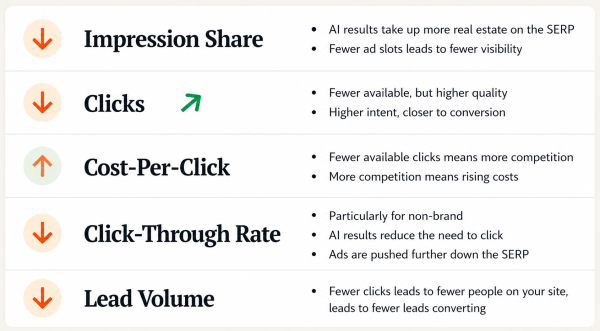
At first glance, this can look like a losing equation. But the story is more nuanced.
With more research happening before students turn to search — through ChatGPT, Gemini, Perplexity, social platforms, and other AI-enabled experiences — they may be arriving at search engines further down the funnel, often to validate what they’ve already learned.
When a student turns to Google now, they may not be asking, “What are my options?” They may be saying, “I know what I’m looking for, and I’m trying to confirm whether this school is the right fit.”
Across several higher ed campaigns, we’re seeing a consistent pattern: fewer clicks, but stronger downstream intent.
- A business school is seeing 17% fewer paid search clicks, but a 16% increase in lead-to-applicant conversion
- A nursing school is experiencing 15% fewer paid search clicks with a 34% increase in lead-to-applicant conversion and a 40% increase in application completion
- A healthcare master’s program with 7% fewer paid search clicks is seeing a 23% increase in lead-to-applicant conversion
So while paid search may not always drive the same volume of leads it once did, it continues to play an important role in reaching high-quality prospective students who are closer to action.
Where Search Still Dominates
Even as the landscape shifts, paid search remains especially valuable in two areas: high-intent, specific queries and branded search.
1. High-Intent, Specific Queries
Students are increasingly using search to answer specific questions, compare options, and move toward a decision. If your keyword strategy is still centered only on broad terms like “college degrees,” you may be missing more valuable mid-funnel and decision-stage queries.
Use keyword planning tools to build a list of program-specific or program-area terms with strong demand (e.g. “computer science master’s”).
Additionally, gather common questions or concerns that your prospects have and turn those into keywords, like “part-time MBA cost” or “PharmD requirements.” Then pair those keywords with landing pages that directly address those needs, using the same language your audience is searching with.
2. Branded Search
Branded search is increasingly important — and often misunderstood. Branded keywords are search terms that include your school or institution name, such as “OHO University.”
As AI tools take over early-stage exploration, students rely on search to land on your school’s website and validate information. That means branded queries are often the final checkpoint before application.
When a student searches your brand, they’re trying to get to you quickly. If you’re not showing up prominently, you’re introducing friction at the worst possible moment. Without a branded ad conveniently sitting at or near the top of the SERP, they may click away, or worse, onto a competitor’s ad.
The Case for Branded Search
It’s tempting to assume branded clicks will happen organically. But that assumption can create risk, especially when prospective students are using search as a final checkpoint before taking action.
There are five reasons branded search still matters:
Competitors
- If you’re not showing up for your own brand, your competitors will. This may or may not be intentional, depending on the match type they use.
- When a competitor ad does show up for your brand, it can redirect high-intent prospects at an even more critical decision point than ever before.
Control
- Well-structured paid search ads show up at or near the top of the search engine results page (SERP). You control the messaging and assets/extensions and ensure prospects are driven to landing pages optimized for conversion (vs. whatever page ranks #1 organically).
- Paid search ads can even be updated quickly to include timely messaging and offerings.
Attribution
- Branded clicks are crucial for connecting digital ad platforms to CRMs, such as Slate, allowing institutions to track the effectiveness of marketing efforts with precision.
- The engagement with these searches is often the first measurable touchpoint for “stealth applicants” who never submit an inquiry but still apply.
Organic Visibility in an AI Search Environment
- Many institutions still underinvest in SEO and AI-era visibility. Without a coordinated organic strategy, institutions have less influence over what prospective students see across search results, AI-generated answers, and other discovery environments. In our experience, strategies that connect organic and paid search are better positioned to adapt to ongoing changes and drive meaningful results.
- AI-generated results are also pushing organic listings further down the page. Paid ads maintain visibility at the top of the SERP.
Efficiency
- Branded campaigns typically deliver higher ad relevance (your ad matches the query, easier to win the bid, in a higher position), stronger click-through rates (users are intentionally searching for you), and cheaper traffic (lower cost-per-click means less investment needed).
- These campaigns also reinforce account authority, increasing your chances of winning and paying less for future auctions, whether branded or not.
How to Evolve Your Paid Search Strategy
You don’t need to scrap your paid search strategy. But it does need to evolve. As student discovery becomes more fragmented and search becomes more validation-oriented, here’s where we recommend focusing your attention:
- Build on this year’s data. Review keyword performance and refine what didn’t perform or convert. Identify and invest in high-intent keywords and branded search.
- Optimize your messaging. Searchers are now more informed and less patient heading into search. Ensure your copy is aligned with their intent and includes clear differentiation and value propositions.
- Explore emerging channels and platform capabilities. Search behavior is no longer limited to Google. Other channels, including TikTok, are adopting keyword-based advertising offerings that may be a fit for your audience. Google is also evolving with new features like AI Max.
- Keep a pulse on search and market changes. These trends will continue to evolve. The institutions that stay closest to the data will be best positioned to adapt.
Search may no longer be the first stop in the student journey, but it remains one of the most important decision points. The institutions that adapt will be better positioned to capture high-intent prospects, protect brand visibility, and compete effectively in a discovery landscape increasingly shaped by AI.
The goal is no longer simply maximizing clicks. It’s ensuring your institution shows up clearly and credibly at the moments that most influence decision-making and enrollment outcomes.