The Real AI Readiness Problem Is Content Readiness
We know AI has become a meaningful part of the college search process.
OHO's latest research found that 40% of actively researching or recently enrolled students used AI for college research, and among those students, AI chatbots and traditional search engines were nearly tied as the first tool they turned to.
But the bigger story isn't how many students are using AI. It's how they're using it.
Students are increasingly asking AI to help them discover, compare, and narrow options before they ever visit an institutional website. They're using AI to answer practical questions that shape real decisions:
- How much does it cost?
- What are my chances of admission?
- What is the graduation rate?
- Which schools fit my interests and goals?
As AI becomes part of the decision-making process, colleges and universities face a new challenge. It's no longer enough to simply publish information online. Institutions also need to ensure that information is clear, accurate, consistent, and easy for both people and AI systems to understand.
The website still matters, but often later
If students are using AI earlier in the journey, does that make institutional websites less important?
Not at all.
OHO's research found that 79% of AI-using students often or always visit a college website after using AI. But increasingly, they're arriving to validate information rather than discover it for the first time.
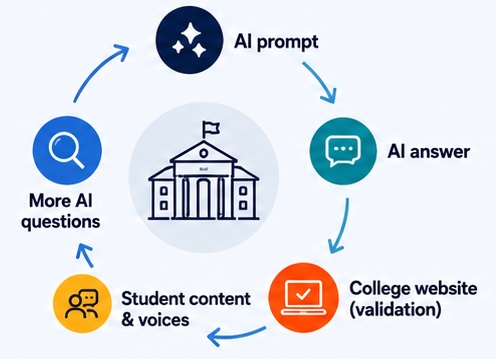
In many cases, AI is helping students create a shortlist before they ever reach your site. By the time they arrive, they're looking for confirmation. They want to verify costs, admissions requirements, outcomes, program details, and whether the institution feels like the right fit.
That makes the website an even more important trust layer. If students are in confirmation mode, critical information shouldn't require a scavenger hunt to find. Cost, requirements, outcomes, and next steps should be easy to locate, easy to understand, and easy to trust.
Most institutions are not ready for this reality
Part of the challenge is that higher education's operating model often creates predictable content readiness gaps.
In decentralized environments, content ownership is distributed across offices, programs, campuses, and vendors. Some areas of the website may be well-maintained and current, while others are outdated, inconsistent, or difficult to govern.
On their own, these issues may seem like routine website maintenance problems. Together, they create real risk.
When institutional information is fragmented, contradictory, outdated, or difficult to interpret, AI has less reliable material to work with. And when information is unclear, AI may look beyond the institution's website to other sources to fill in the gaps.
What once felt like content governance challenges are increasingly becoming visibility, accuracy, and credibility challenges.
Many institutions don't simply have a visibility problem. They have an interpretation problem.
AI is exposing places where institutional content is unclear, inconsistent, or difficult to trust. That is what content readiness is meant to address.
What content readiness looks like in practice
Content readiness isn't just about keeping pages up to date.
It's about ensuring that your institution's most important information is accurate, consistent, easy to find, and easy for both people and AI systems to understand.
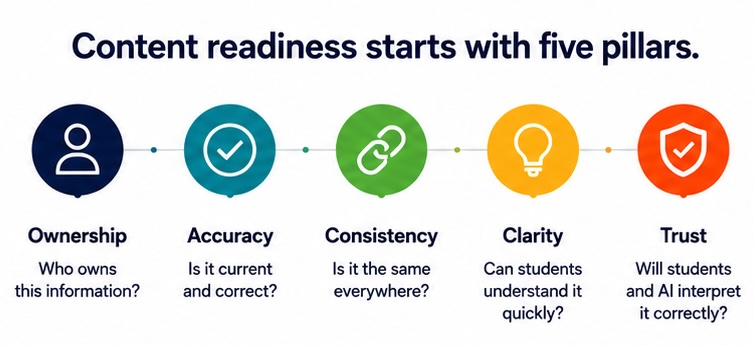
In practice, that means being intentional about which content is authoritative, who owns it, where it lives, and how consistently it appears across your digital ecosystem.
A practical starting point includes:
- Defining clear ownership for high-stakes information such as cost, admissions requirements, deadlines, and outcomes
- Establishing a single source of truth for critical facts
- Creating clear validation-focused pages that help students quickly confirm what they've learned elsewhere
- Answering student questions directly using plain, scannable language
- Ensuring important information appears prominently on the page
- Maintaining consistency across websites, campaign pages, catalogs, microsites, and other digital properties
- Regularly reviewing how AI systems are representing the institution and identifying areas where content may need clarification or correction
Content readiness extends beyond the primary website.
Campaign landing pages, departmental sites, catalogs, microsites, and other digital properties all contribute to how an institution is understood. When those experiences contain conflicting information or unclear ownership, students become confused—and AI systems do too.
The goal is not simply to publish more content. It's to present a clear, consistent picture of the institution wherever its content appears.
This is bigger than a search update
It's tempting to view AI through the lens of search, but the shift is broader than that.
The challenge is no longer simply whether institutions can show up online. It's whether they can be represented clearly, accurately, and consistently in the places where students increasingly begin their research.
A few questions are worth bringing back to your team:
- Do we have clear source-of-truth content for the questions students care about most?
- Are we helping prospective students validate and compare information, or primarily asking them to convert?
- Where do conflicting facts or duplicate content still exist across our digital properties?
- Who owns the information AI systems are most likely to repeat?
- How often do we review the accuracy and consistency of that information?
These may sound like tactical questions, but they're really questions about institutional readiness.
As AI becomes a larger part of how students research colleges and universities, the challenge isn't simply showing up. It's making sure your institution is represented accurately, consistently, and credibly wherever students encounter it.
The institutions that solve that problem will be better positioned not only for today's AI-shaped search experience, but for whatever comes next.