AI Visibility Doesn’t Stop with Your School’s Website
While SEO and GEO have overlapping tactics, they are different in one key area: Location. SEO is primarily focused on optimizing content on the website to improve a web page’s search ranking. GEO should be focused on placing relevant (and optimized) content on your website and on other websites that LLMs view as credible and that are frequently used as citations.
Platforms such as ChatGPT and Gemini assemble responses using information from across the web. LLMs reference an institution’s website (roughly 50-85% of the time depending on the platform), and LLMs also cite third-party sources they consider authoritative, current, and easy to interpret.
Top Third-party Sources for LLMs
- Higher education aggregators – Niche, Princeton Review, Big Future, and Poets & Quants
- Social Media – Reddit, Facebook, and student reviews from Niche
- Wikipedia – a fallback source for LLMs if there are gaps or unclear content on a school website
- Other sites – college admissions coaching sites, student newspapers, local media, blogs
AI search introduces an important change: your institution’s website is no longer the only place where your content can influence an answer.
For higher education marketers, this shift creates a new content-distribution opportunity. AI search optimization does not happen just on the college or university website. Now content can also be published on other websites that LLMs regularly consult and consider credible.
Let's break down what content should be found on each of these sites to best reinforce a key message or accelerate indexing into LLMs.
1. Press Releases and Wire Services
Press releases are the most underused AI-search opportunities available to higher education institutions.
Through our AI Visibility Scorecards, we are seeing content distributed through services such as PR Newswire surface in AI-generated answers. In one institutional analysis, PR Newswire was the school’s most frequently referenced third-party source.
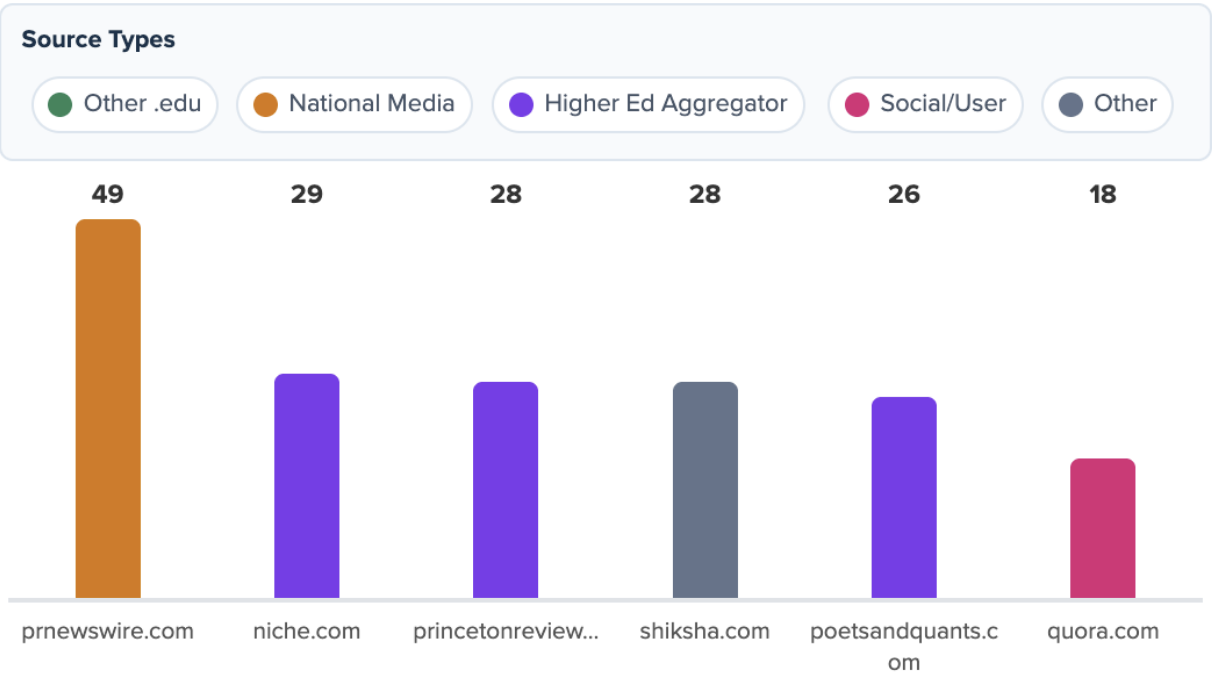
Fact-based announcements can help establish information about an institution in a source outside its own domain, and posts can provide critical student outcomes and student-life stories. Potential topics include:
- New academic programs
- College or university rankings
- Student and alumni outcomes – highlight ROI data, career advancement
- Distinctive educational experiences – such as experiential learning
- Showcase student career outcomes
- Demonstrate leadership in a particular area – such as AI
- Expand faculty expertise and public-service content
- Feature first-generation and international student support
The strongest releases go beyond the timely hook. They will provide specific facts and connect the news to the institution’s broader story.
For example, a press release announcing a new graduate program could include information about employer demand, the program’s curriculum, experiential learning opportunities, faculty expertise, and the types of roles graduates will be prepared to pursue. Those details make the content more useful to journalists and more relevant to AI search platforms.
2. Higher Education Aggregator Sites
Higher education aggregator websites and school discovery platforms – such as Niche, Princeton Review, and Poets & Quants – are another important part of the AI-search ecosystem.
In our AI Visibility Scorecards, we find that both ChatGPT and Gemini cite information from sites such as Niche, to answer questions related to the student experience and to find easy-to-digest comparison data and facts.
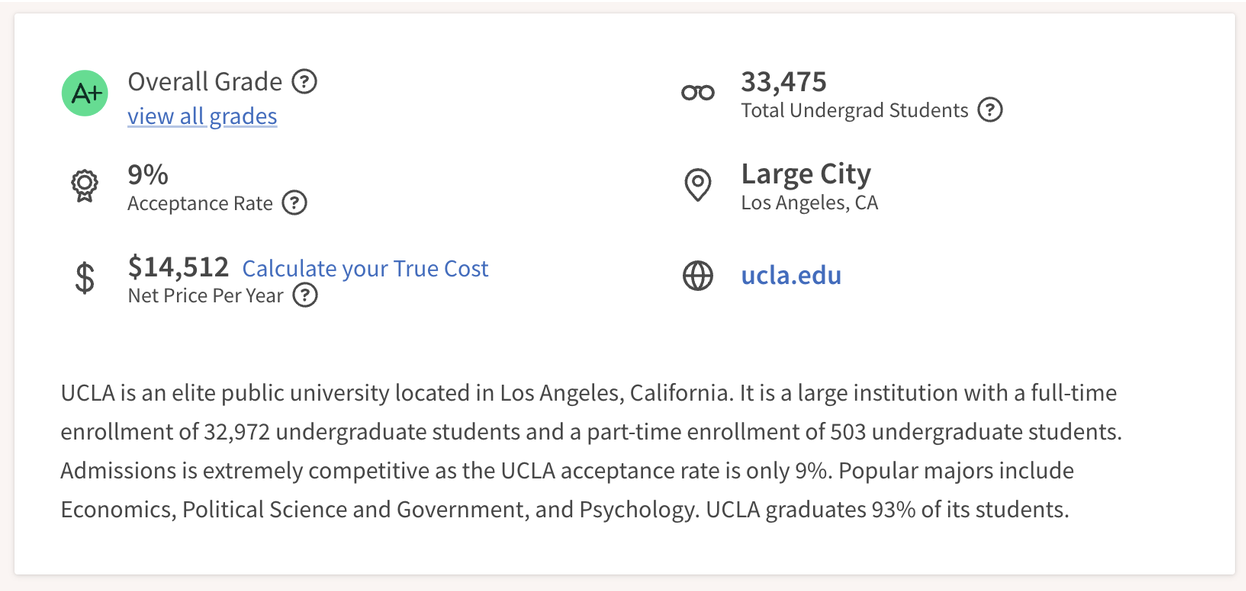
Since institutional information is presented in consistent, structured formats, Niche and other higher education aggregator sites make content easy for LLMs to find, interpret, and compare.
For marketers, the priority is simple: own your school’s profile and keep it current. Where possible, claim your profile and make sure academic information, outcomes, key facts, and institutional differentiators are accurate and consistent with what prospective students will find on your website.
If a paid profile gives you opportunities to publish additional content, think strategically about how you use that space to introduce your school and highlight key reasons to choose a school, outcomes information, and academic and student experience stories.
You may be tempted to copy and paste the same content across every platform, but that will end up hurting you more than helping. The goal is to tell a consistent story across all the sources AI engines are using with content and messaging best suited for that particular channel.
If an LLM turns to one of these platforms for information about your institution, you want it to find the same key facts, proof points, and differentiators that you’ve worked hard to establish on your own website.
3. Student Newspapers
Much to the chagrin of many marketers, college student newspapers are also frequently referenced in AI search results.
Student newspaper websites are used to round out the campus life picture in AI responses.
Student publications contain reporting on campus decisions, academic programs, student organizations, leadership changes, events, and the lived student experience. That reporting can become part of the information AI platforms use to explain what is happening at an institution.
For marketers, the opportunity is not to publish more content through the student newspaper. The priority is understanding, awareness, and potential engagement with the editorial staff.
- What topics are receiving sustained coverage?
- How are students describing their experiences?
- Are there outdated articles that continue to appear prominently in search?
- Are there recurring concerns or misconceptions that should be addressed through clearer institutional content?
Monitoring student publications can help marketing teams understand the external narrative surrounding the institution, and they can reveal content gaps on the university website. When a student newspaper becomes the clearest available source on an important topic, it may be a sign that the institution needs to publish a more complete explanation of its own.
4. LinkedIn – Credible but underused by higher ed
AI search engines can access publicly available LinkedIn content that doesn’t require a login, including articles and the company profile pages. There is an important caveat: in our research to date, we have not seen LinkedIn cited frequently in AI-generated answers about higher education institutions.
This low citation rate may simply reflect how colleges and universities are currently using the platform. Many institutions use LinkedIn primarily to distribute short social posts and links rather than publishing substantive, long-form content directly on the platform.
There’s a second benefit to posting beyond AI search. LinkedIn generally favors content that keeps users on its platform rather than immediately sending them somewhere else. Publishing useful content natively can therefore support your LinkedIn engagement strategy while also creating another publicly accessible source that AI engines may be able to discover.
5. YouTube – An Opportunity to Optimize
YouTube is another valuable and trusted source for AI search – particularly for Gemini, given YouTube’s place within Google’s ecosystem.
But, like LinkedIn, we’re not currently seeing YouTube cited frequently in our higher education persona research. To date, less than 1% of the sources we’ve analyzed have come from YouTube.
When higher ed marketing teams intentionally optimize YouTube videos – improving titles, descriptions, transcripts, and summaries – we see those videos get picked up and cited in AI-generated answers much more frequently.
And YouTube has something particularly valuable for higher education: first-person student content. Consider the video content many institutions already have sitting in their video libraries:
- Student stories and testimonials
- Day-in-the-life videos
- Campus and program experiences
- Faculty interviews
- Alumni outcomes
- Student panels and Q&As
This content provides the type of authentic, first-person perspective prospective students are looking for when they ask AI platforms questions about the student experience. It also gives AI engines more institutionally owned material to draw from. Instead of relying primarily on Reddit, LinkedIn, or other third-party sources to understand what students think about your institution, well-optimized YouTube content can supplement those perspectives with student voices published and maintained by the university.
Building an AI Visibility Strategy – How to Get Started
Improving AI Visibility for a college or university includes a few key steps:
- Understand the content sources and content gaps – you’ll need a persona-driven approach and a tool to analyze
- Develop content to fill content gaps in your AI answers and place this optimized content on your website or on credible websites
- Rescan your AI presence with the same process used in step 1 to ensure that your content is being picked up and used to shape answers that AI is telling about your school
If you need help getting started, sign up for a free AI Visibility Scorecard for your school. We can base the analysis on ChatGPT or Gemini using any of our student prospect personas – undergraduate, graduate, executive education, transfer student, or community college.