
The AI Driven College Search - 2026 Research Report
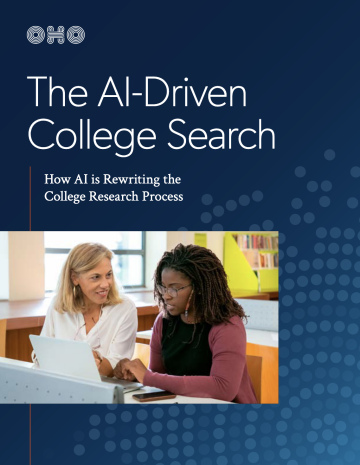
40% of college-bound students now use AI to research schools, up from 8% in 2023. Is your institution showing up in those answers, and is the information accurate?
Artificial intelligence is reshaping the college search process — not uniformly, and not yet for everyone — but for a significant segment of prospective students, and at a pace that demands attention from enrollment and marketing teams.
Download the 2026 Research Report to learn:
How fast the college search has changed. See how AI use in college research grew from 8% to 40% in three years, and why students now treat AI as a decision-making partner rather than a search tool.
Where the search begins now. AI tools have overtaken traditional search engines as the first place many students go. Learn how AI builds shortlists, removes schools from consideration, and helps students find schools they’d never heard of.
Why students trust AI answers they never check. Nearly two-thirds of AI-using students rate AI as accurate, often because citations are visible even when they don’t click them. Find out what that means when AI gets your institution wrong.
The new three sources students trust. AI guides the search, peer content shows what a school is really like, and your website confirms the decision. Learn how each one shapes students’ choices, with real student journeys as examples.
Five steps to take now. Get a practical plan to check how AI represents your school, make key content easy for AI to read, and turn AI visibility into an ongoing part of enrollment marketing.
Download the Report
The AI-Driven College Search: What Our 2026 Research Found
Published: Last updated:
Students are asking AI where they should apply. Here’s what that looks like, and what it means for your school.
Picture a high school senior typing “good colleges for engineering” into ChatGPT. A few seconds later, they have a list. They haven’t been to a single college website yet but are already decided a few things based on the information has been presented to them.
This is happening a lot more than you might think. In our 2026 national survey, about 4 in 10 students ages 17–22 who were looking at colleges (or had just started college) told us they use AI to research schools. Back in 2023, it was 8%.
Here’s what we learned, and what you can do about it.
The quick version
- About 4 in 10 students use AI to research colleges (40.4% of students ages 17–22 who were researching schools or recently enrolled). That’s up from 8% in 2023.
- AI and Google are neck and neck as the place students start. Among students who use AI, 35.8% started with AI and 31.2% started with a search engine. Only about 1 in 10 started on a college website.
- AI changes the list. 73.5% of these students found schools they hadn’t thought of, and half crossed schools off.
- Students trust it. 64.7% say AI answers are accurate, up from about half in 2024.
- They still visit your website. 78.8% often or always do after getting AI answers. Not one student said rarely or never.
- Even “non-AI” students see AI. 75.8% of students have reviewed the AI overviews seated at the top of Google search results.
How many students use AI to look at colleges?
About 4 in 10. Among students ages 17–22 who were researching colleges or had just enrolled, 40.4% use AI to research schools. And that number has climbed fast:
| Year | Used AI chatbots at all | Used them to research colleges |
|---|---|---|
| 2023 | 48% | 8% |
| 2024 | 59% | 18% |
| 2026 | 68% | 40% |
What's more impactful than the fact that students use AI in their college search is how they use it. They’re not just playing around with it. They’re leaning on it to help make one of the biggest decisions of their lives.
Where do students start their college search now?
For students who use AI, it’s basically a tie between AI and Google.
| Where they started | Share of students |
|---|---|
| An AI tool like ChatGPT | 35.8% |
| A search engine like Google | 31.2% |
| A college website | 10.9% |
| Parents, friends, or counselors | 10.9% |
| Social media | 6.3% |
| Rankings | 6.2% |
Why does this matter? Whatever a student sees first shapes everything that comes after. If AI hands them the list, your website’s job becomes helping them check it.
What are students asking AI?
Pretty much what they’d ask a guidance counselor. Students who use AI ask it to:
- find colleges (63.2%);
- understand their options (58.8%);
- get recommendations (51.5%);
- narrow down their list (51.5%);
- compare schools (48.5%).
It changes their thinking. Among these students:
- 73.5% found new schools;
- 55.9% got clearer on what they want;
- 50% crossed schools off;
- 44.1% felt more confident in their choice.
Their questions sound like this: What schools are best for my major? Can I get in? How much will it cost? Which of these two is better? What jobs can I get?
Stuff that used to take a dozen browser tabs and a whole weekend now happens in one chat conversation.
Do students trust what AI tells them?
Mostly, yes. 64.7% of students who use AI say its answers are accurate. In 2024, it was 50.7%.
Interestingly, the share who call AI “extremely accurate” actually dipped a little. Students aren’t starry-eyed about AI. They just think it’s giving information good enough to act on.
Unfortunately, most don’t double-check. Nearly two-thirds trust AI’s answers without clicking through to the sources. More than three-quarters have gotten answers about a college without ever visiting its website.
We call this the credibility illusion. When an AI answer shows its sources, students trust it more, even if they never click those links. One student told us he never checks the sources, but he believes they’re right.
So, if AI gets something wrong about your school, the student probably won’t catch it, and you might never know.
Are students still visiting college websites?
Yes, and that’s good news. 78.8% of students who use AI often or always visit the college’s website after getting AI answers. Not a single student said rarely or never.
But they’re coming for a different reason. They’re not browsing anymore. They’re double-checking what AI told them.
Your website still matters a lot. Its job has just changed. It’s where AI gets its facts about you, and it’s where students go to make sure those facts are right.
What about the AI answers at the top of Google?
They count, and they reach almost everyone. Even students who say they don’t use AI for college research are seeing it every time they Google a school. More than 9 in 10 students have seen those AI summaries, and 75.8% have used them.
Among students who use AI to research colleges:
- 72.3% used tools like ChatGPT or Gemini;
- 69.1% used the AI answers in Google;
- 51.1% used AI built into their browser or other apps.
So, the impact of AI on college search is reaches beyond their conversation with ChatGPT, influencing the process almost everywhere a student looks.
Who do students trust now?
Three places, and each has its own job:
- AI helps them figure out where to look. It builds the list and helps them compare.
- Other students show them what it’s really like. TikTok, Instagram, YouTube, and LinkedIn posts from real students feel honest because nobody’s selling anything.
- Your website confirms it. It’s where they check the facts and decide whether you’re the real deal.
Put simply: AI gives them the list, other students give them the real story, and your website seals the deal. We call this the Reordered Trust Framework.
Does every student use AI the same way?
Nope. Here are two students from our research who used AI in totally different ways.
Nico, the practical decision-maker. Nico is the first in his family to go to college. He wanted to study engineering at a school near home in Baltimore. He started in ChatGPT, checked tuition in Google’s AI summary, and only stopped by the university’s website to look at the cost table. For Nico, AI helped him avoid a risky choice, and the website was a quick fact check.
Tia, the experience seeker. Tia is a blend of several students we talked with. Students like her start with a feeling, like “a medium-sized school with a creative vibe.” AI turns that feeling into a list. Then they head to TikTok and YouTube to see if the vibe is real. For Tia, AI’s list is a first guess, real students are the proof, and your website shows them who you are.
Different students need different things from you:
| Type of student | What they care about | How they use AI | How they use your website |
|---|---|---|---|
| Practical undergrad | Cost, location, chances of getting in, jobs | Main research tool | Checking specific facts |
| Social undergrad | Campus culture, community, fitting in | A starting point | Getting a feel for the place |
| Research grad student | Faculty, advisors, labs, reputation | Some background research | Faculty profiles and research details (a must) |
| Professional grad student | Return on investment, jobs, salary, cost | Comparing outcomes and cost | Confirming program and outcome data |
And remember: lots of students still don’t use AI for this. Don’t drop what’s working for them. Think of AI as one more thing to get right, not a replacement for everything else.
What should your school do now?
Five steps to start with:
- Ask AI about yourself. Ask ChatGPT, Gemini, and Claude the same things students ask: your programs, admissions, cost, outcomes, and how you compare to other schools. Write down what’s wrong or missing.
- Make your most important info easy to find. That means admissions, cost, programs, outcomes, faculty, and student life. Use plain words, and don’t hide key facts in PDFs or fancy interactive tools.
- Build your site for checking and exploring. Put cost, requirements, and outcomes one or two clicks away. Keep the stories that help students picture themselves on campus.
- Let students tell your story. Give student ambassadors real freedom, and share what they make on your website.
- Keep checking. AI answers change all the time. Make watching them part of someone’s regular job, not a one-time project.
About the research
This report comes from OHO’s 2026 national survey, done in February 2026. We heard from 530 people, including 327 students who were either actively researching colleges or had recently started. We also interviewed students, held focus groups, and watched students search for colleges live on their screens.
The research was led by Jim Dalglish, an independent researcher who studies how people use websites and digital tools. It builds on more than 10 years of OHO research: over 150 surveys, 80,000+ survey responses, and 2,000+ interviews and focus groups.
A quick note: these findings describe students who use AI to research colleges, not every student. AI hasn’t changed the college search for everyone yet, but it has for a big and growing group.
How to cite this research: OHO. (2026). The AI-Driven College Search: How AI Is Rewriting the College Research Process. https://www.oho.com/ai-driven-college-search-2026-research-report
Frequently asked questions
How many students use AI to research colleges?
About 4 in 10. In OHO’s 2026 survey, 40.4% of students ages 17–22 who were researching colleges or had just enrolled said they use AI to research schools. That’s up from 8% in 2023.
Is AI replacing college websites?
No. 78.8% of students who use AI often or always visit a college’s website after getting AI answers, and none said rarely or never. They’re just coming to double-check facts instead of browsing.
What is the “credibility illusion”?
It’s our name for something we saw over and over: students trust AI answers more when they show sources, even though they rarely click on them. That means wrong or outdated info about your school can stick without anyone noticing.
Do Google’s AI summaries count?
Yes. More than 9 in 10 students have seen the AI answers at the top of Google, and 75.8% have used them. That includes students who say they don’t use AI for college research.
How was this research done?
We surveyed 530 people in February 2026, including 327 students, then followed up with interviews, focus groups, and live screen-sharing sessions. Independent researcher Jim Dalglish led the work.
Want the whole story?
The full report has all the data, more student stories, and step-by-step recommendations. Get the 2026 Research Report, complete and submit the download form below.
Curious what ChatGPT, Claude, and Gemini are telling students about your school right now? Get a free AI Visibility Scorecard review